
Wandering and Restlessness — Finding Safety Through Connection

Wandering is one of the most common and distressing behaviors among individuals living with dementia. Research estimates that six out of ten people with dementia will wander at some point during their journey. While it’s often perceived as aimless or dangerous, wandering is rarely random. It’s an expression of need — a physical manifestation of confusion, anxiety, or the search for familiarity.
A person may be looking for a loved one, trying to return to a past home, or simply seeking movement when feeling bored or overstimulated. For caregivers, this can be deeply worrying. Safety concerns often lead to locked doors or alarm systems, but those measures don’t address the underlying cause — the individual’s need for connection, purpose, and calm.
Recent studies show that sensory engagement can help reduce agitation and restlessness, providing a healthy outlet for energy and curiosity. When the hands are active and the senses stimulated, the mind relaxes. Engagement offers comfort in place of confusion — and a bridge back to safety and presence.
When Movement Speaks
For Emily, wandering wasn’t a statistic. It was her mother, June, pacing the hallway every afternoon at three o’clock. June would walk the same loop — past the kitchen, down the hall, back to the door — whispering, “I need to go home.”
At first, Emily tried to reason with her. “Mom, you are home.” But reasoning only deepened June’s frustration. “No,” she’d insist, “not this one. The real one.”
As the weeks went on, Emily learned that logic couldn’t soothe fear. June’s body moved because her mind needed comfort. Music helped for a few minutes. Folding towels kept her busy, briefly. But nothing stopped the restless pacing for long.
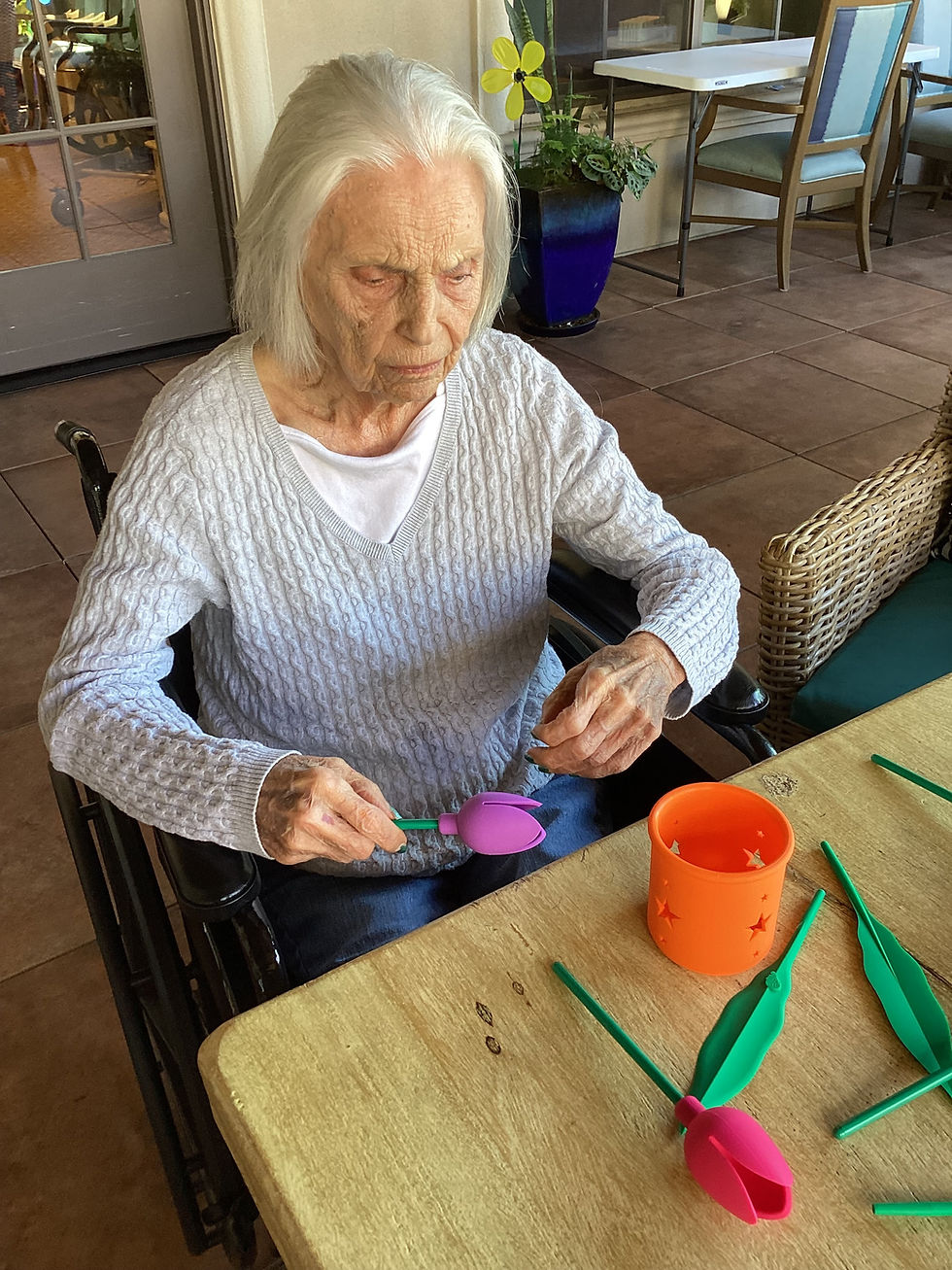
One afternoon, the care community’s activity coordinator approached Emily with something new: a small bucket filled with colorful silicone pieces. “They’re called Geri-Gadgets®,” she said. “They might give her something to focus on.”
Skeptical but willing, Emily handed one of the pieces to her mother. June turned it over in her palm, tracing its soft, flexible edge. Then she rubbed it once, twice, her shoulders slowly relaxing. Minutes passed. The pacing stopped.
The next day, Emily brought the tugger. “Can you help me stretch this one, Mom?” she asked. June sat. She began to twist it, stretch it, and smile. For the first time in months, her feet were still.
A week later, the activity coordinator placed several Geri-Gadgets® pieces on a table. June joined a small group of residents, each exploring the shapes, comparing colors, and sharing laughs. “She looks like herself again,” Emily whispered.
That night, Emily wrote in her journal: For the first time in months, I sat beside Mom and didn’t feel like I had to stop her from leaving. We were both home.
From Wandering to Wonder
Wandering and restlessness often reveal unmet needs — not just in dementia, but across conditions like autism, ADHD, stroke recovery, and Parkinson’s. Movement can be a language of emotion, expressing, “I need something to do. I need to feel safe.”
When caregivers respond to that language with empathy and engagement, behavior changes. Sensory stimulation redirects energy from anxiety to curiosity, from agitation to focus. It doesn’t eliminate movement — it gives it meaning.
That’s the principle behind Geri-Gadgets®. Each SafeTouch™ sensory tool is made from medical-grade, non-toxic, dishwasher-safe silicone — designed to feel soft, safe, and familiar. These tactile, interactive products offer calm through touch, helping caregivers replace confusion with connection and movement with purpose.
Because safety isn’t always about barriers. Sometimes, it’s about giving someone something meaningful to hold — something that reminds them they’re still connected, still capable, still seen.
Even when memory fades, the need for connection and comfort never does.
Angela Fairhurst
Founder & CEO, Geri-Gadgets®
Keywords: dementia wandering, sensory engagement, SafeTouch sensory tools, caregiver support, agitation relief, non-pharmacological dementia care, senior safety, engagement activities for dementia, cognitive therapy tools, Geri-Gadgets


Comments